LIMINAL SPACES
Liminal spaces have become an internet aesthetic whereby photographs of places which are meant to be traversed (implying a temporary stay) are framed and presented as a final image. These spaces imply where people should be, but are not. The aesthetic also spreads to depictions of empty nostalgic spaces and the internet has branched into themed subgenres of liminal space (such as the backrooms, the poolrooms, the sublevels etc).
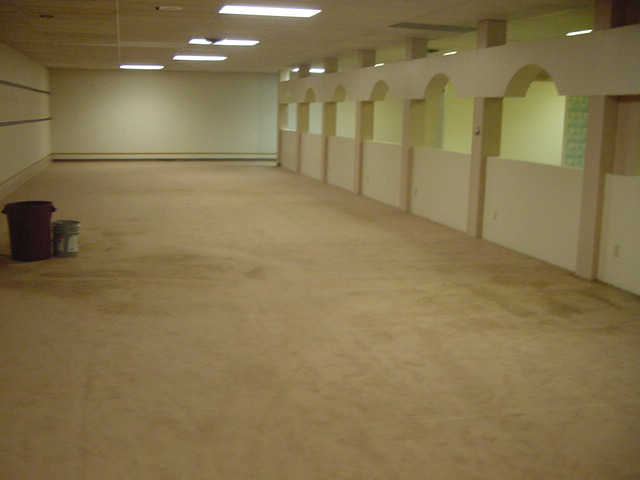
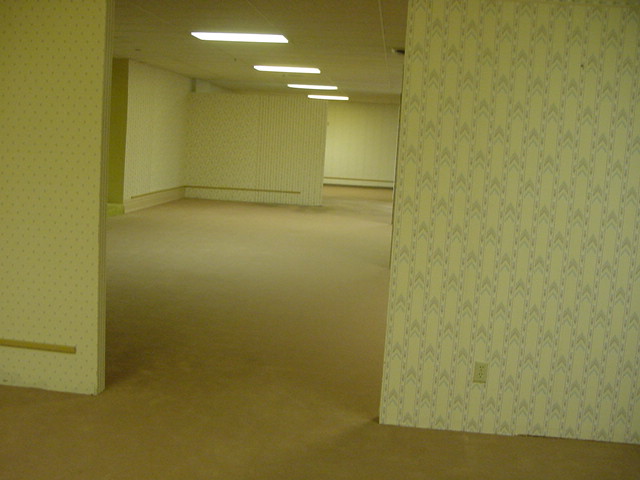
However, this love/fear relationship with eerie architecture did not
begin
online.
Liminal spaces have existed since there has been architecture, and depictions have been included in books such as House of Leaves and artwork such as Deimos by Dragan Bibin.
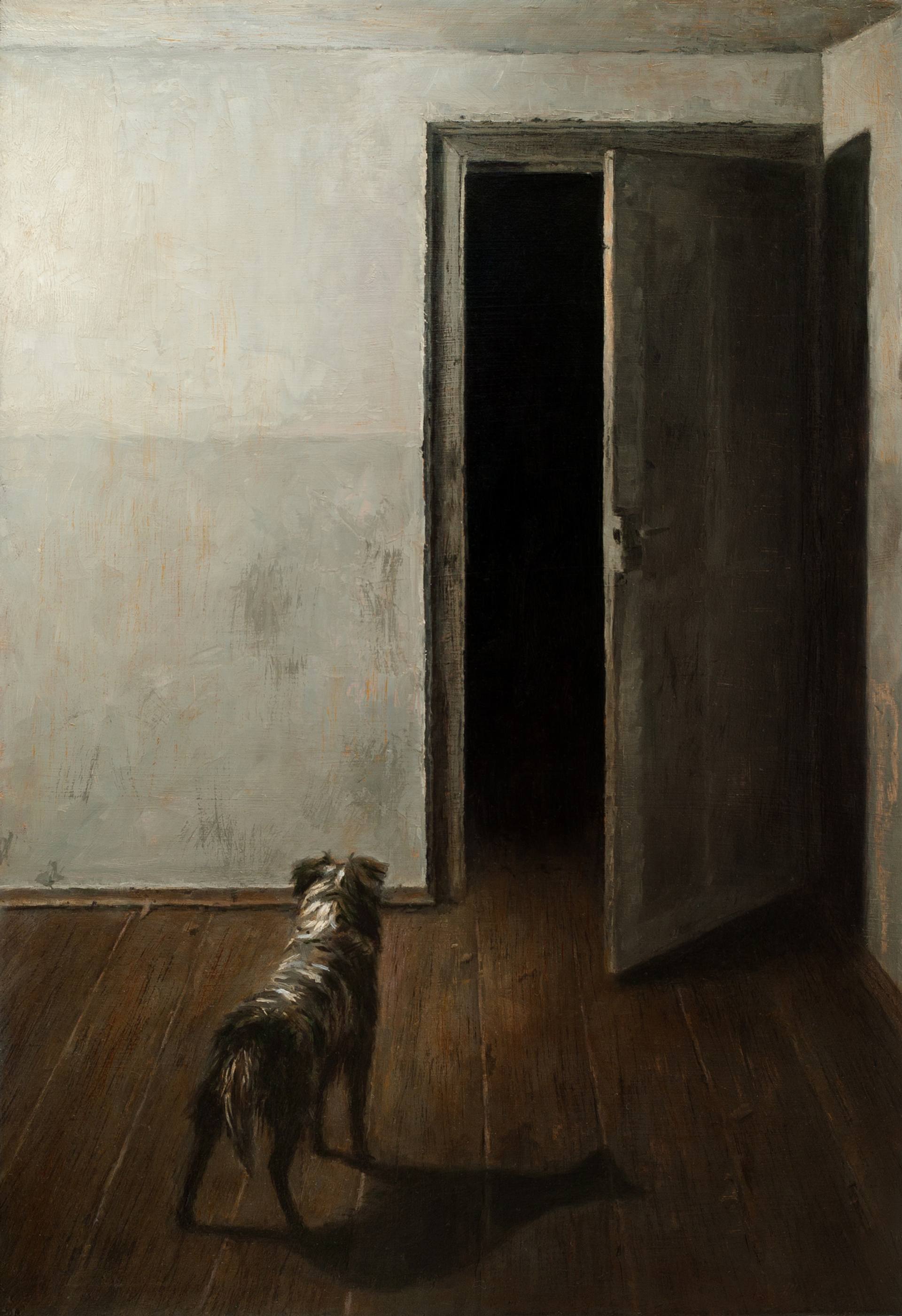
Bibin's work in his painting series The Human Condition focuses on the human as the animal trapped within artificial spaces and the uncanny dread which this evokes.
Indeed, liminal spaces existed back when I was doing my art GCSE in the 00s, before the term "liminal space" had even been coined. I studied making rooms inside boxes and painting geometric perpendicular rooms. I wasn't the first. I studied other artists. Dorothea Tanning. Rene Magrite. Georgio Chirico.


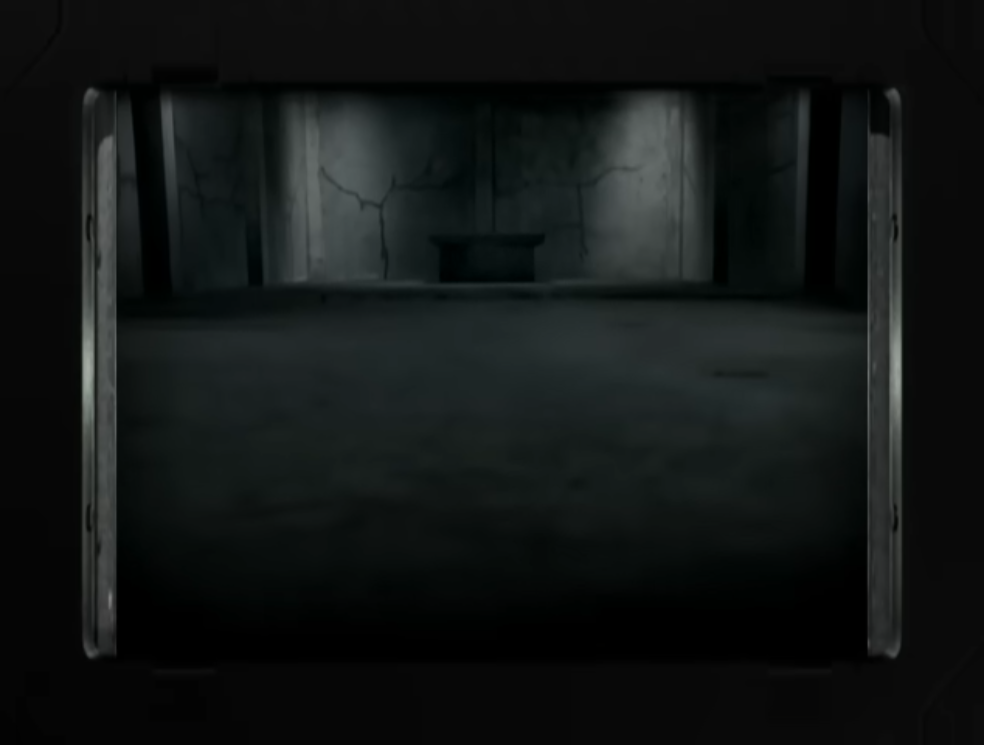
They existed in TOOL videos in 2002. Peek it through this doorway.
Winchester Mystery House

BRUTALISM
Liminal spaces exist in Brutalist architecture as an artform, which is a physical assault on the senses in its sheer lack of detail, its utilitarian bluntness, its smack-flat concrete stone fascade.Moshe Linke devours Brutalism in works like Fugue in Void and Brutalism: Prelude on Stone.
Liminal horror is body horror for a place.
Borges
Jorge Francisco Isidoro Luis Borges was a master of liminal spaces. He wrote about the intellectually uncanny in a way only he knew how. You may recognise one of his masterworks - the Library of Babel. A near-infinite library of books: each book is of four hundred and ten pages; each page, of forty lines, each line, of some eighty letters.
Amongst these books are fundemental truths of human nature. There are false histories and true biographies with the wrong endings (and also the same biographies with the right endings). The text of this essay is in the library. It has every combination of letters possible to make all stories and facts, and all fictions and lies, but it's all mostly jibberish.
The library is not sorted in any particular way, nor do its custodians work on sorting it. Instead, they have broken into factions which search feverishly for books which contain some semblance of sense. Finding a book with a single word is difficult among the infinite shelves of nonsense. Making sense out of jibberish is a Sisyphean task. An infinite torture.
Borges was an expert in reducing and paring down concepts into their core elements, and his work with spaces and the degredation of "the original" were revolutionary. Examples include The Circular Ruins, The Library of Babel and Pierre Menard, Author of the Quixote.
I cannot recommend the collection of these stories, Ficciones, more.
In a way, liminal spaces are best defined as the fear of a void.
In a way, liminal spaces are best defined as the fear of decay.
In a way, liminal spaces are best defined as the fear of the unknown.
In a way, liminal spaces are best defined as the fear of repetition.
In a way, liminal spaces are best defined as the fear of silence.
theft of identity. infinity. dream states. forgetfulness. nostalgia. loss of all we had. repetition. the loss of home. hiraeth. epheremality. repetition. desire. being hunted. change. architecture. technology. being lost. being forgotten. repetition. megalophobia. the uncanny. the unheimliche. echoes. sound without sight. oppression. freedom. imprisonment. transience. loss of control. unfamiliarity. the mundane. labyrinths. urbanophobia. claustrophobia . agoraphobia. batophobia. the unforgiving nature of it all just sprawling out ahead, a memory dribbling from your mind's eye like brains on a carpet never to return or even make sense to you if it does and who built this thing anyway and why is it so familiar but different and why am i here and how do i get out and when did all this come to exist, a great pile of familiar materials built in familiar shapes in a whole which is unfamiliar, a corpse of meaning, a spatial palatial palace of someone else's mind not mine, it was never mine, unless it was and i no longer remember or recognise it
It's the feeling of living in a modern day that our biology wasn't built for. It took millions of years to evolve a sense of taste so we knew which berries to eat in the environment we evolved in. Stone architecture has only been here for a couple of thousand years. Consumer electronics have been around for maybe fifty. Our biology is running software meant for legacy practices. The technology must cater for our frailties.
What does it mean when our technology and architecture works against us?
BUT
Beyond this horror, there is so much to love. Liminal spaces are a deconstruction of rooms and places. They are a celebration of maths, of architecture, of interior design. It's a delight in the unknown, the desire to explore, the longing for more. It is self-exploration and it is savouring the unpicking of the threads of the known in order to understand it better.
Jared Pike's Dream Pools series breaks down the aesthetic of swimming pools. Uncanny yet soothing. It's wrong but it clicks.
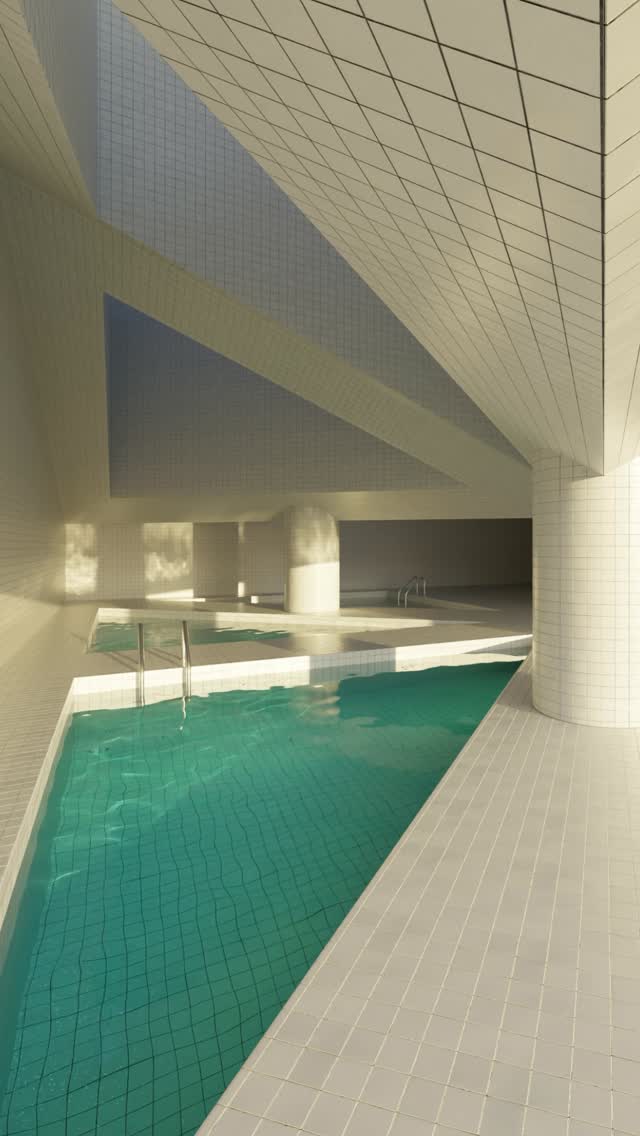
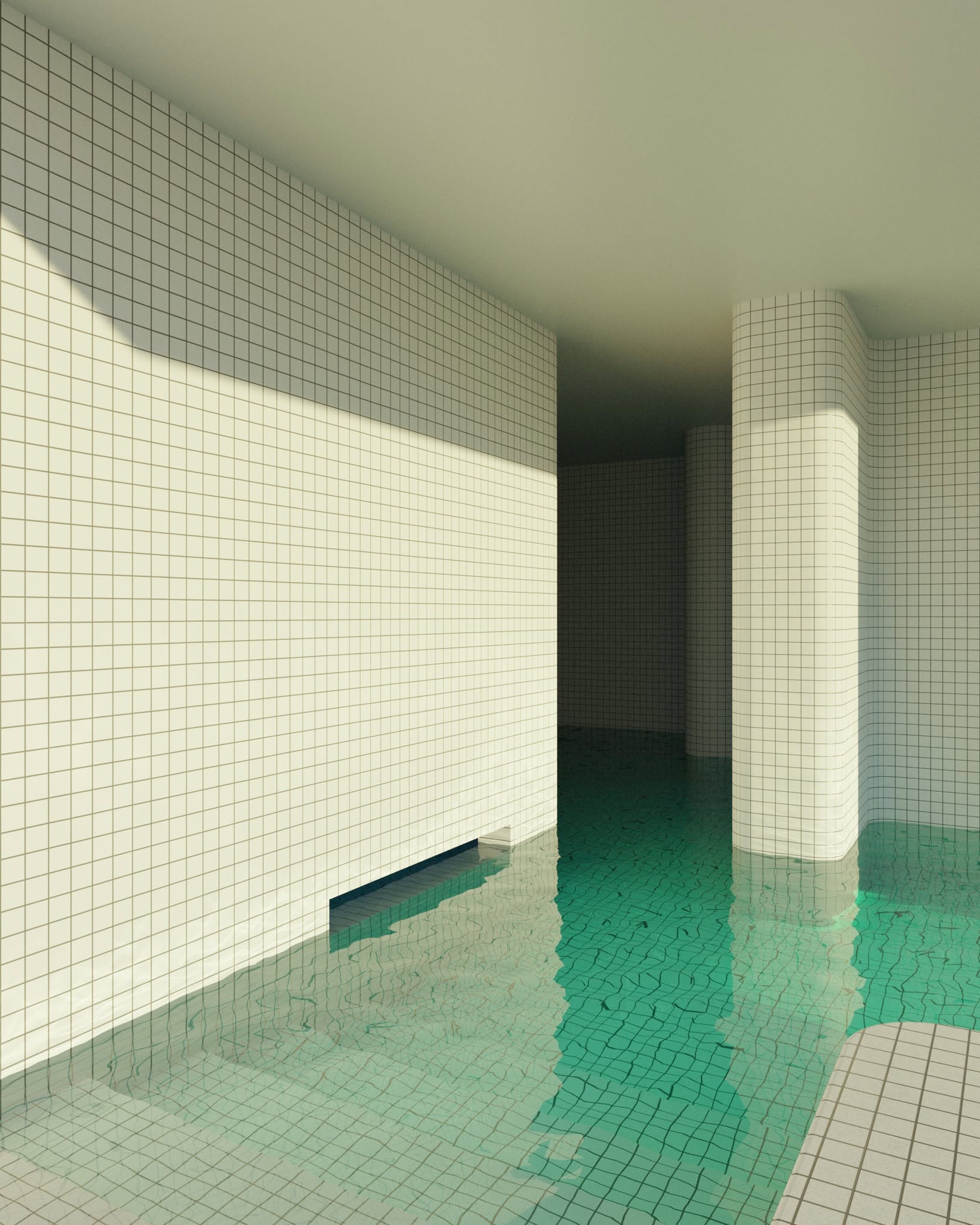
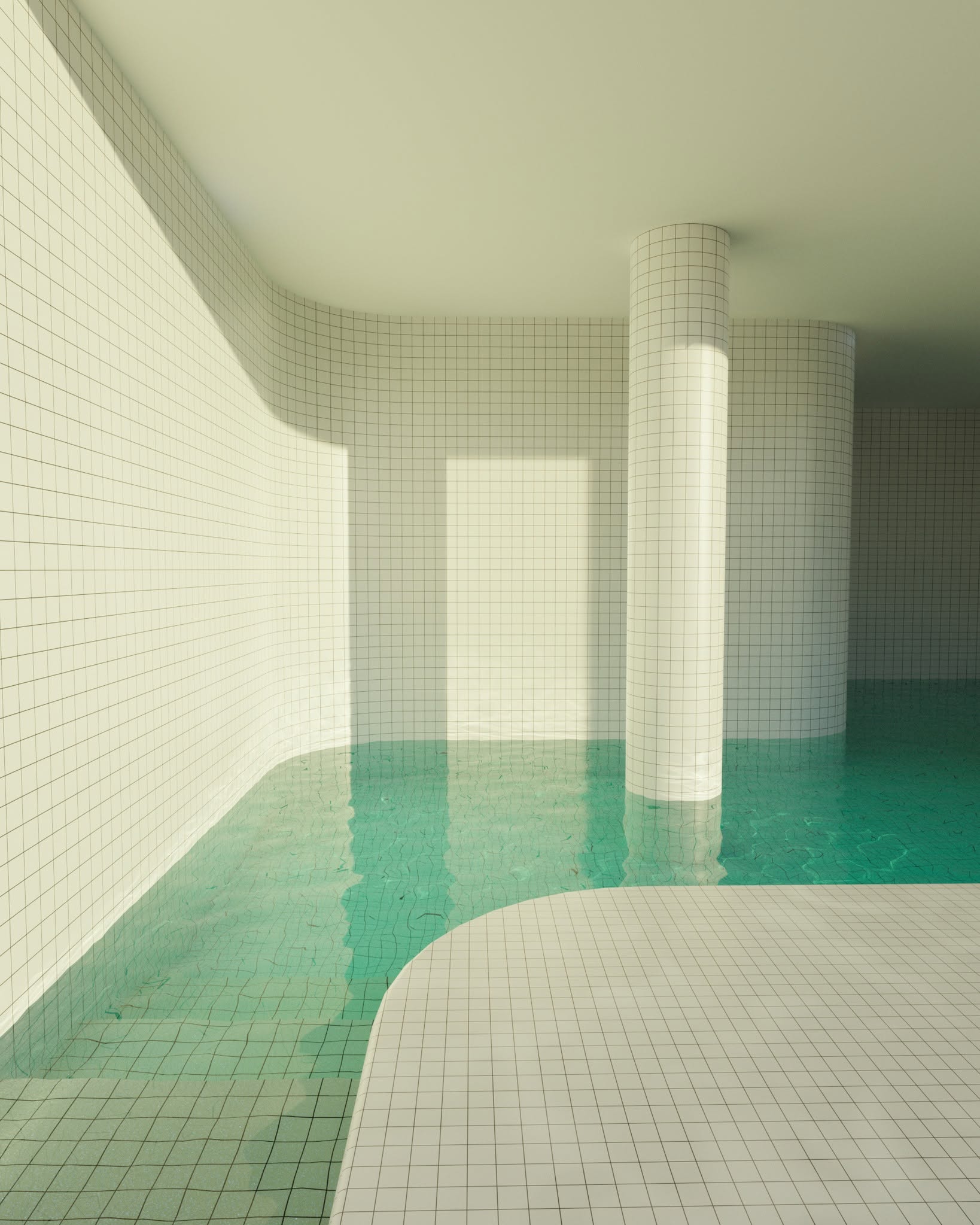
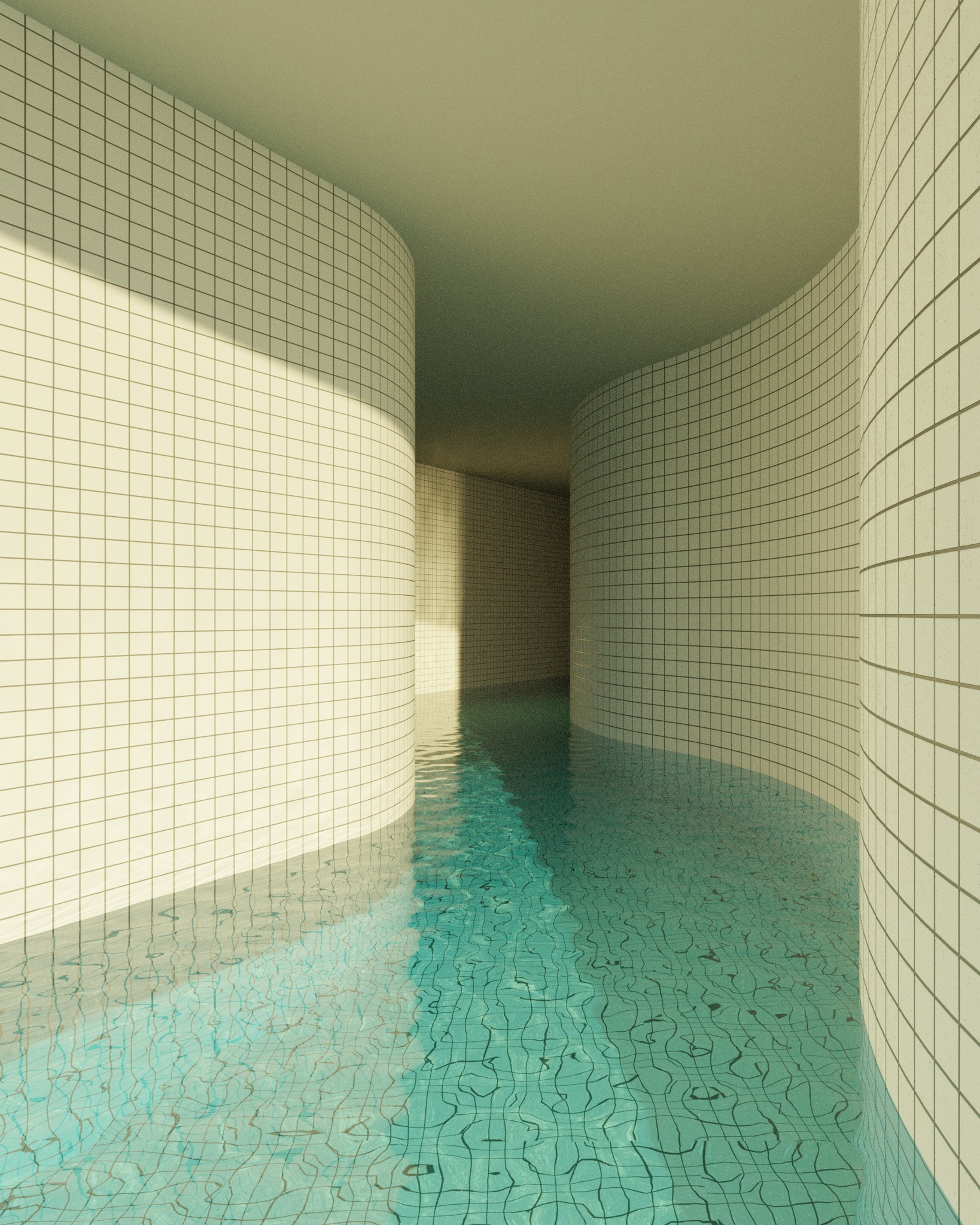
Beyond the curvature of the wall, in the shadows, in the unseen windows which cast light but are out of view, there is more to explore and more to find. It is possibly endless.
It is impossibly endless.
And you'll note that throughout it all, in these empty spaces filled with nobody, there is no evidence that the viewer is there either. No cast shadow, no footprints. No ripples.
FAMILIAR
Liminal spaces are familiar, like you've been there before, like a memory. Even if you've never been there or seen that place before.
It taps into the communal subconscious by using common tropes of memory and older things. Dated media like VHS and steadycams and SONY cameras and graffiti and widely sold toys and old wallpaper and novelty pool fixtures and tiles and carpet and office ceiling tiles and the hum of electric lights and the clouding of fog and crowding darkness and gaussian blur and obfuscated corners like the edges of photographs of an old house you grew up in or pictures of unfamiliar people that have long since passed into the memory of the past. Your memories are all there, somewhere in your subconscious, tied to these triggers of oldness, and tie these images to a forgotten memory, or more accurately, a false memory.
FAMILIAR
Liminal spaces are familiar, like you've been there before, like a memory. Even if you've never been there or seen that place before.
It taps into the communal subconscious by using common tropes of memory and older things. Dated media like VHS and steadycams and SONY cameras and graffiti and widely sold toys and old wallpaper and novelty pool fixtures and tiles and carpet and office ceiling tiles and the hum of electric lights and the climbing of steps and stairs into the subconscious below, the mind's basement, the body's final resting place, joining those people in the old house you grew up in and the unfamiliar people who occupy it. You too have become the past. Your memories are all there, somewhere in your subconscious, tied to these triggers of oldness, and tie these images to a forgotten memory, or more accurately, a false memory.
Memento Mori
As with anything which evokes the idea that our lifetime is finite and fleeting, liminal spaces are often associated with death and rebirth. The death of the self is the obvious theme, but the birth of the new space, the infinite halls and permeations, are typically born from the visitor entering the space. In simpler terms, these places are given life by our dead memories.
This is both sad and comforting.
just a burning memory
In a similar vein, the music which accompanies liminal spaces uses the orchestra of old media to dredge your memories. The Caretaker's album "Everywhere at the End of Time" wields a phonograph's crackle to great effect, and uses Al Bowlly's "Heartaches" as its main sample material to work its decay. Not only is this song from a time before most living people's experience, but it's also a reference to The Shining, where a (different) Al Bowlly track plays nostalgically (hopefully?) at the end.
Mr Terrance has simultaneously frozen to death and remains frozen in time as the Outlook's caretaker.
Liminal tracks use the aesthetics of circuit bending: phaser wobble, subtle microtoning, detuned synths, tape warble, cutting samples, repetition, reverb, echo. They replicate the feeling of a broken device in an abandoned hallway.
Dreamcore, weirdcore, vaporwave, synthwave, dark synthwave, Dariacore, signalwave, disintegrating tape loops, barberbeats and ambience all use similar techniques to explore sampled tracks and instruments.
The orchestration is just as important as the effects. The sounds carry the artefacts of destortion and decay.
The experience of liminal spaces has a lot in common with...
- Caving
- Ikea
- The Mall
- Exploring game maps via noclip
- Turning your head to see something hidden on a screen, despite this not having any effect.
- Butterfly collecting
- Looking through gaps in doors or through tight spaces which your body cannot access but your mind can
- Fun houses and halls of mirrors
- 1920s Dadaism and surrealism
- Videogame eastereggs
- Through the Looking Glass
NO MONSTERS
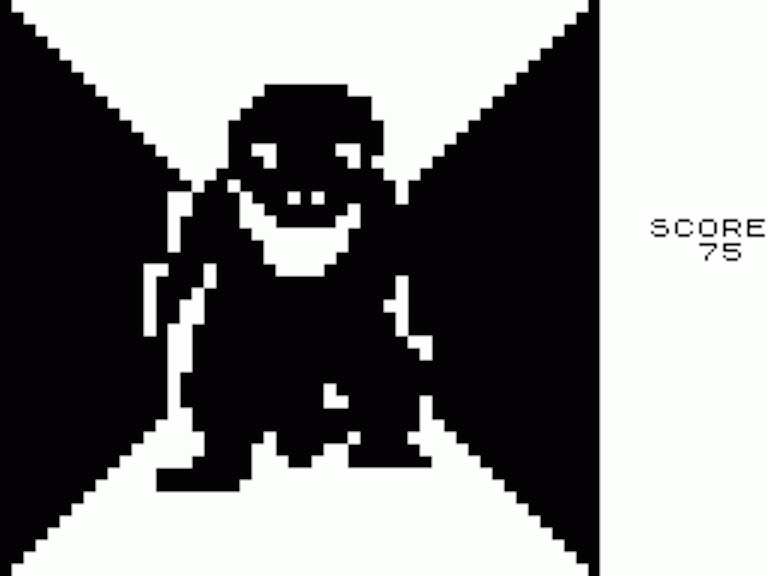
A good liminal space requires no monsters. The space is the monster. It exists when it should not. Its purpose is not clear. You are trapped inside of it. It has devoured you. You are already digested.
If your liminal space requires a monster, you have missed the point of the liminal space and why it is scary.
Inevitably, web series, creepypasta and films will have a monster. They must have a monster because to not have a monster is to be without a resolution. Roaming monsters are easy to understand. You must run away from the monster. They want to eat you. It is the primal fear of the lizard brain.
Liminal spaces are an intellectual horror - the vestigal disease of a hundred million years of evolution which allows us to read and operate door handles but keeps us scared of a pile of clothes in a chair at 1am. The urgent call of the void.
You can't run away from a liminal space.
You can't outsmart a liminal space.
You can't trap a liminal space.
You can't fight a liminal space.
Even if you escape the space and return to reality, the memory will remain.
The curiosity is forever.
It is the thirst to know.
It is what killed the cat.
It is why you scrolled to the end.